The five sources of supply chain blind spots
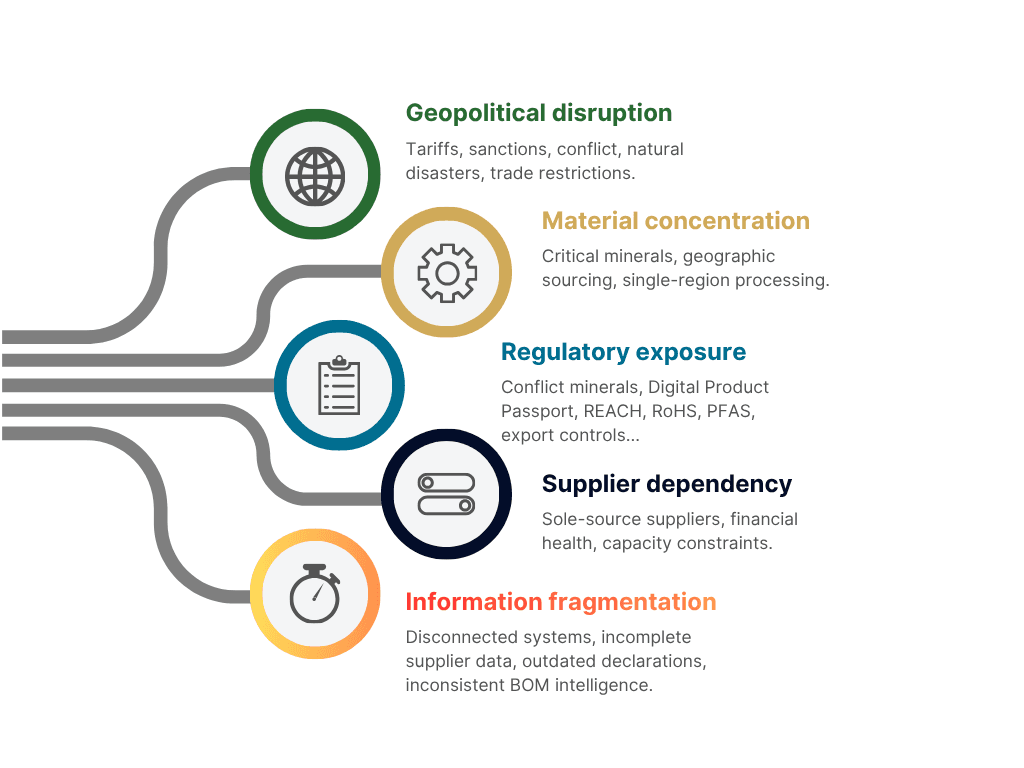
Volatility rarely comes from a single event. It emerges when organizations cannot see how multiple risks intersect across their supply chain.
A single component may depend on a sole supplier, contain a newly restricted substance, rely on a critical mineral sourced from a high-risk region, or be affected by tariffs, export controls, or conflict. These risks are often managed in separate systems, making it difficult to understand their combined business impact.
The challenge is not a lack of data. Most organizations already have access to vast amounts of supplier, engineering, and compliance information. The real challenge is connecting these signals quickly enough to understand where risk is emerging and what it means for the business.
The five sources of supply chain blind spots below provide a practical framework for identifying where visibility is most often lost and where organizations can strengthen their ability to anticipate, assess, and respond to change.
Supplier dependency – Sole-source suppliers, financial health, capacity constraints.
Material concentration – Critical minerals, geographic sourcing, single-region processing.
Regulatory exposure – REACH, RoHS, PFAS, conflict minerals, export controls.
Geopolitical disruption – Tariffs, sanctions, conflict, natural disasters, trade restrictions.
Information fragmentation – Incomplete supplier data, outdated declarations, inconsistent BOM intelligence.
This fifth category is arguably the most important because it amplifies the other four. Organizations are rarely surprised because a risk exists; they are surprised because they couldn't see the risk early enough or understand its impact across products and suppliers.
As supply chains become more interconnected, understanding how these risks converge may become a greater competitive advantage than understanding any single risk in isolation. Want to learn more? Let's talk.


